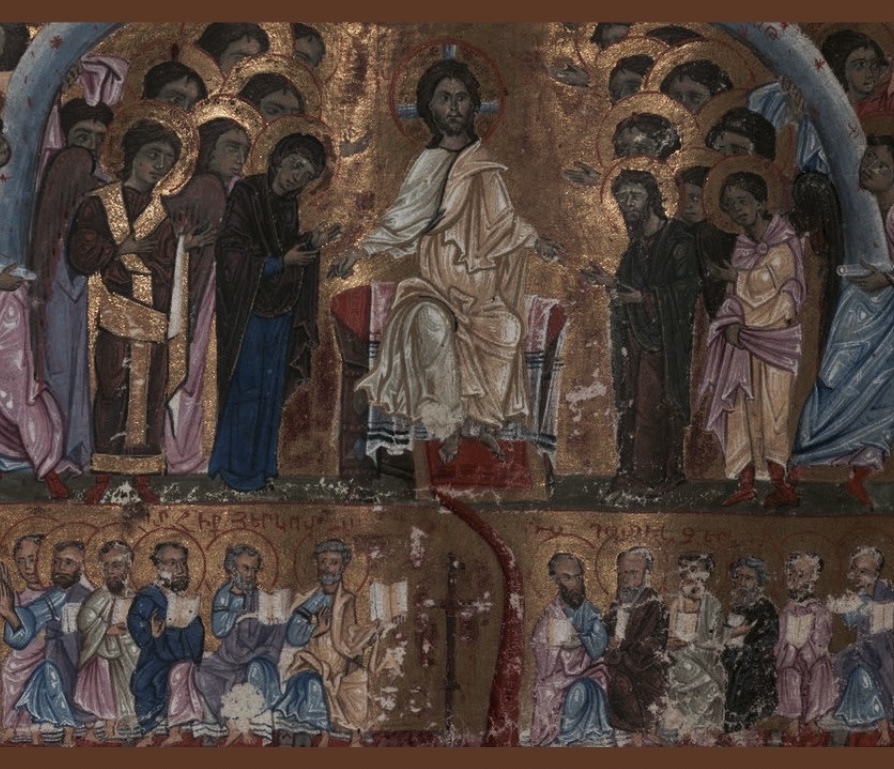
Definition of Terms:
|
The Catholic Understanding of Heaven: Beatific Vision, Communion, and Eternal Ascent
I. What the Church Means by “Heaven”
In Catholic theology, Heaven is not primarily a location within the cosmos but a state of definitive communion with the Triune God, the fulfillment of human destiny. The Catechism defines Heaven as:
“The ultimate end and fulfillment of the deepest human longings, the state of supreme, definitive happiness” (CCC §1024).
At its core, Heaven consists in the Beatific Vision—the direct, unmediated vision of God “face to face” (1 Cor 13:12). This vision perfects the intellect, fulfills the will, and establishes the soul eternally in love.
Thus, Heaven is:
- personal (communion with God),
- ecclesial (communion with saints and angels),
- transformative (participation in divine life),
- eternal (beyond time and decay).
II. Biblical Foundations for Heaven
Scripture speaks of Heaven both directly and symbolically, often exceeding human language.
A. Heaven as Communion with God
- John 17:3
“And this is eternal life, that they may know you, the only true God, and Jesus Christ whom you have sent.”
Eternal life is defined relationally—as knowing God, not merely existing forever.
- 1 John 3:2
“What we will be has not yet been revealed. What we do know is this: when he is revealed, we will be like him, for we will see him as he is.”
The promise of seeing God “as he is” grounds the doctrine of the Beatific Vision.
- Matthew 5:8
“Blessed are the pure in heart, for they will see God.”
B. Heaven as Fulfillment and Joy
- Revelation 21:3–4
“See, the home of God is among mortals… death will be no more; mourning and crying and pain will be no more.” - Psalm 16:11
“In your presence there is fullness of joy; in your right hand are pleasures forevermore.”
C. Symbolic Descriptions: Streets of Gold
- Revelation 21:18–21 describes gold, jewels, and radiant light.
The Church has consistently understood such imagery as symbolic, conveying:
- incorruptibility,
- glory,
- immeasurable value,
- divine beauty.
Gold signifies permanence; light signifies divine presence; precious stones signify transformed creation.
III. Figurative Language and Patristic Interpretation
A. Heaven Beyond Physical Imagery
The Fathers repeatedly warned against crude literalism.
St. Augustine wrote:
“If the streets are gold, what must the householder be?”¹
For Augustine, material imagery is accommodated language, pointing beyond itself.
Origen similarly argued:
“These descriptions are not bodily delights, but spiritual realities expressed in figures.”²
Thus, “streets of gold” were understood as analogical, not architectural.
IV. The Early Church’s Understanding of Heaven
A. Heaven as Participation in Divine Life
The early Church understood Heaven primarily through the lens of theosis (divinization), especially in the East.
- 2 Peter 1:4
“You may become participants of the divine nature.”
This verse was foundational for patristic eschatology.
St. Irenaeus of Lyons taught:
“The glory of God is man fully alive, and the life of man consists in beholding God.”³
B. Heaven as Growth Without End
One of the most profound patristic insights is that Heaven involves eternal growth, not static stasis.
St. Gregory of Nyssa articulated this famously through the concept of epektasis—eternal ascent:
“The soul’s desire is never satisfied, but always advances toward God.”⁴
This idea is often paraphrased as “always further up and further in” (later echoed by C.S. Lewis).
Gregory taught that because God is infinite, the soul’s participation in God is endlessly deepened, even in Heaven.
V. Heaven as Communion with the Saints
A. The “Great Cloud of Witnesses”
- Hebrews 12:1
“Therefore, since we are surrounded by so great a cloud of witnesses…”
The Church has consistently understood this as implying conscious, living communion between the Church on earth and the saints in Heaven.
St. Cyprian of Carthage wrote:
“Let us remember one another in concord and unanimity… let us pray for one another always.”⁵
Death does not sever communion; it perfects it.
- Luke 20:38
“He is God not of the dead, but of the living; for to him all of them are alive.” - Revelation 6:9–11 shows saints conscious, praying, and awaiting fulfillment.
St. John Chrysostom preached:
“The martyrs are not absent from us; they are present and aware.”⁶
Thus, Heaven is not remote but interpenetrating, hidden rather than far away.
VI. Heaven and the Resurrection of the Body
Catholic doctrine affirms that Heaven is:
- experienced immediately by the soul after death (Particular Judgment),
- perfected after the resurrection of the body (Final Judgment).
- 1 Corinthians 15:42–44
“It is sown a physical body, it is raised a spiritual body.”
The resurrected body will fully participate in heavenly glory—transfigured, not discarded.
VII. Heaven as Love Perfected
At its deepest level, Heaven is perfect love:
- 1 Corinthians 13:12–13
“Now I know only in part; then I will know fully… And now faith, hope, and love abide, these three; and the greatest of these is love.”
Faith gives way to sight. Hope gives way to possession. Love remains forever.
As St. Bernard of Clairvaux later summarized:
“The cause of loving God is God Himself; the measure of loving Him is to love without measure.”⁷
VIII. Conclusion
The Catholic understanding of Heaven is neither naïvely literal nor abstractly vague. It is:
- biblically grounded in communion, vision, and joy,
- patristically rich, emphasizing transformation and ascent,
- relational, centered on God and the communion of saints,
- dynamic, involving eternal growth into infinite Love.
Descriptions such as “streets of gold” were never meant as blueprints but as sacramental signs pointing to a reality “no eye has seen, nor ear heard” (1 Cor 2:9).
Heaven is not merely where God is—it is life in God, forever.
References & Footnotes
Scripture
John 17:3; 1 Cor 13:12–13; 1 Cor 15:42–44; 2 Pet 1:4; Matt 5:8; Rev 6:9–11; Rev 21:3–4, 18–21; Ps 16:11; Heb 12:1; Luke 20:38.
Church Fathers
- Augustine, City of God, XXII.
- Origen, On First Principles, II.11.
- Irenaeus, Against Heresies, IV.20.7.
- Gregory of Nyssa, Life of Moses, II.231–239.
- Cyprian, On the Lord’s Prayer, 17.
- John Chrysostom, Homilies on the Martyrs.
- Bernard of Clairvaux, On Loving God, I.1.
Magisterial
- Catechism of the Catholic Church §§1023–1029.
Church Father Quotes:
St. Irenaeus of Lyons (c. 130 – c. 202)
“The glory of God is a living man; and the life of man consists in beholding God.”
— Against Heresies, IV.20.7
Origen of Alexandria (c. 184 – c. 253)
“The saints shall see God face to face, and knowing Him, shall be transformed into His likeness.”
— On First Principles, I.1.9
St. Cyprian of Carthage (c. 210 – 258)
“What a great and delightful thing it will be, beloved brethren, when we shall see God, when we shall be honored to share the joy of eternal salvation and light.”
— Treatise on Mortality, 26
St. Athanasius of Alexandria (c. 296 – 373)
“He became man that we might become god.”
— On the Incarnation, 54
St. Basil the Great (c. 329 – 379)
“The enjoyment of God is eternal life, and the delight of the soul in God is beyond all description.”
— Homily on Psalm 33, 6
St. Gregory of Nyssa (c. 335 – c. 395)
“This truly is the vision of God: never to be satisfied in the desire to see Him.”
— Life of Moses, II.239
St. John Chrysostom (c. 347 – 407)
“To be with Christ—this is the kingdom, this is heaven, this is joy beyond all joy.”
— Homilies on Philippians, Homily 3
St. Augustine of Hippo (354 – 430)
“There we shall rest and see, see and love, love and praise. This is what shall be in the end without end.”
— City of God, XXII.30