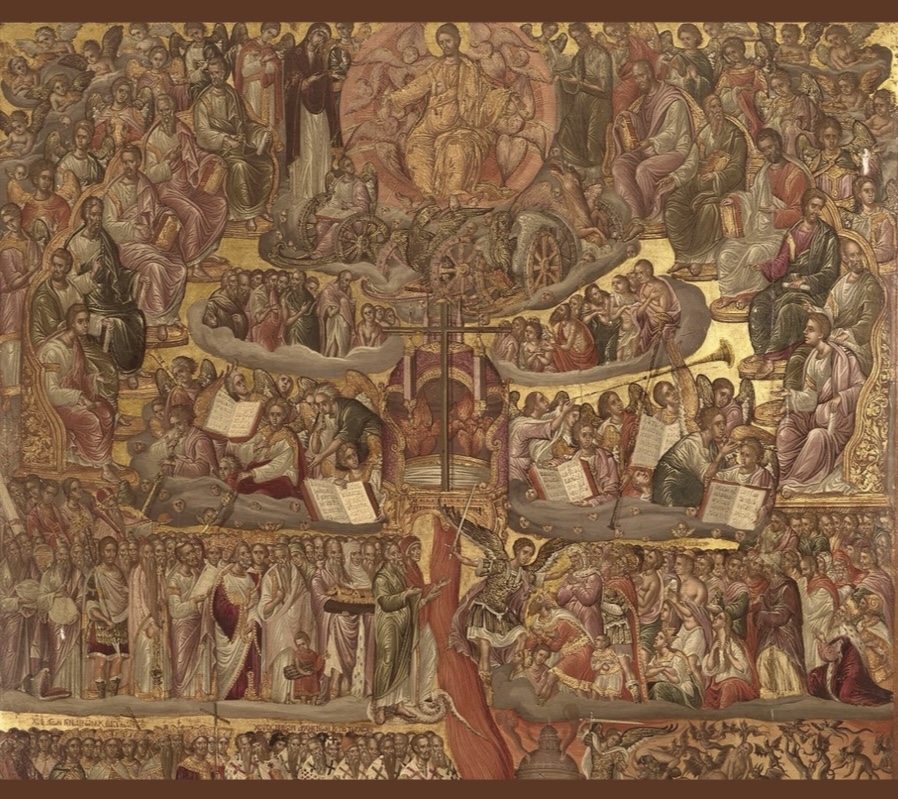
Definition of Terms:
|
The Catholic Doctrine of Particular Judgment: Death, Judgment, and the Encounter with Christ
I. Defining Particular Judgment
In Catholic theology, Particular Judgment refers to the immediate judgment of each soul by Christ at the moment of death, determining its eternal destiny: heaven (immediately or through purification), or hell. This judgment is distinct from—but complementary to—the Final (General) Judgment, which occurs at the end of time and publicly manifests God’s justice and mercy.
The Catechism summarizes the doctrine succinctly:
“Each man receives his eternal retribution in his immortal soul at the very moment of his death” (CCC §1022).
Particular Judgment emphasizes the personal and definitive character of death: after death, the soul’s orientation toward or against God is fixed.
II. Biblical Foundations of Particular Judgment
While Scripture does not use the technical term “particular judgment,” the concept emerges clearly from the biblical witness when read holistically.
A. Judgment Immediately After Death
Several passages indicate a decisive reckoning at or immediately after death, not merely at the end of time.
- Hebrews 9:27
“It is appointed for men to die once, and after that comes judgment.”
This verse establishes a sequence: death, then judgment—without any indication of delay until the general resurrection.
- Luke 16:19–31 (The Rich Man and Lazarus)
Lazarus is carried to “Abraham’s bosom,” while the rich man is in torment, prior to the final resurrection. Their fates are already determined. - Luke 23:43
“Today you will be with me in Paradise.”
Jesus promises the repentant thief immediate post-mortem communion, implying an individual judgment rendering such a state possible.
B. Conscious Reward or Punishment Before the Final Judgment
- 2 Corinthians 5:6–10
“We would rather be away from the body and at home with the Lord… For we must all appear before the judgment seat of Christ.”
Paul presents a personal appearing before Christ, linked closely with death.
- Philippians 1:21–23
“My desire is to depart and be with Christ, for that is far better.”
Paul assumes that death leads directly to a personal encounter with Christ.
- Revelation 6:9–11
The souls of martyrs are conscious, rewarded, and awaiting final vindication—again presupposing a prior judgment.
C. Distinction from the Final Judgment
Scripture also teaches a Final Judgment (Mt 25:31–46; Rev 20:11–15), but this judgment:
- is public and cosmic,
- involves the resurrection of the body,
- manifests what has already been determined.
The Catholic synthesis recognizes both judgments without contradiction.
III. Theological Meaning of Particular Judgment
Particular Judgment is best understood as:
- personal (each soul individually judged),
- immediate (occurring at death),
- definitive (fixing the soul’s eternal orientation).
It is not a trial in time, but an encounter with Truth Himself.
As St. John writes:
“This is the judgment, that the light has come into the world” (Jn 3:19).
Judgment is fundamentally relational—the soul stands before Christ, and its true disposition is revealed.
IV. The Eastern Christian Understanding
A. The East: Judgment as Encounter and Illumination
Early Eastern Christianity emphasized judgment as an encounter with divine light, rather than a juridical trial.
Origen (3rd century) described judgment as exposure to divine truth:
“Each one is judged by the very fact of seeing himself as he truly is.”¹
For many Eastern Fathers, heaven and hell are not separate “places” imposed externally, but different experiences of the same divine presence.
B. The Soul’s State After Death
Eastern Fathers clearly taught immediate post-mortem recompense, though often with less juridical precision than later Western theology.
St. Cyril of Jerusalem wrote:
“After departing from the body, the soul goes to receive either reward or punishment.”²
St. John Chrysostom emphasized moral accountability:
“When we depart from here, we are led away to judgment.”³
C. Intermediate State and Growth
The East also maintained a sense of mystery and dynamic expectation:
- the soul awaits the resurrection,
- the Final Judgment completes what is already known,
- the righteous rest in peace, the wicked in anguish.
This perspective harmonizes naturally with the Catholic understanding of Particular Judgment followed by Final Judgment.
V. The Western Patristic Understanding
A. Greater Juridical Precision
Western Fathers—particularly Augustine—developed the doctrine with greater conceptual clarity, without departing from biblical faith.
St. Augustine taught unequivocally:
“When a man dies, he is immediately judged.”⁴
He distinguished:
- the private judgment of the soul,
- the public judgment at the resurrection.
B. Moral Finality at Death
Augustine stressed the fixity of the will after death:
“As a man dies, so he is judged.”⁵
This conviction underlies the Catholic teaching that conversion is not possible after death.
VII. Particular Judgment in the Economy of Salvation
Particular Judgment underscores several key Catholic convictions:
- Human freedom matters eternally (Gal 6:7–8).
- Death ends the time of merit (Heb 3:15).
- Salvation is personal, not collective (Rom 14:12).
- Christ Himself is Judge (Jn 5:22).
It is therefore not a doctrine of fear, but of moral seriousness and hope.
As Paul writes:
“There is laid up for me the crown of righteousness, which the Lord… will award me on that Day” (2 Tim 4:8).
VIII. Conclusion
The Catholic doctrine of Particular Judgment is deeply biblical, firmly patristic, and theologically coherent. Scripture teaches that:
- death is followed by judgment,
- the soul enters a conscious state of reward or punishment,
- final judgment publicly confirms what is already determined.
The Eastern Fathers emphasized judgment as encounter with divine light and truth; the Western Fathers clarified its juridical and definitive character. Together, they testify to a unified early Christian belief: each soul meets Christ immediately after death.
Particular Judgment, then, is not merely an event—it is the final unveiling of a life lived before God.
References & Footnotes
Scripture
Heb 9:27; Lk 16:19–31; 23:43; Jn 3:19; 5:22; Rom 14:12; 2 Cor 5:6–10; Phil 1:21–23; Gal 6:7–8; Rev 6:9–11; Mt 25:31–46; Rev 20:11–15.
Eastern Fathers
- Origen, Homilies on Jeremiah, 20.
- Cyril of Jerusalem, Catechetical Lectures, 18.
- John Chrysostom, Homilies on Matthew, 28.
Western Fathers
- Augustine, Sermon 172.
- Augustine, Enchiridion, 111.
- Gregory the Great, Dialogues, IV.39.
Magisterial
- Catechism of the Catholic Church §§1021–1022.
Church Father Quotes:
St. Justin Martyr (c. 100 – c. 165)
“Each man goes to everlasting punishment or salvation according to the value of his actions.”
— First Apology, ch. 12
St. Irenaeus of Lyons (c. 130 – c. 202)
“When the soul departs from the body, it immediately goes to the place appointed for it by God, and there awaits the resurrection and the judgment.”
— Against Heresies, V.31.2
Tertullian (c. 155 – c. 220)
“All souls, therefore, are shut up within Hades, and there await the judgment day, whether good or bad.”
— De Anima (On the Soul), ch. 58
St. Hippolytus of Rome (c. 170 – c. 235)
“The souls of the righteous are in the hand of God… but the unrighteous are dragged to the place appointed for them.”
— Against Plato, On the Cause of the Universe, ch. 3
Origen of Alexandria (c. 184 – c. 253)
“Each one departs from this life to receive according to what he has done, whether good or evil.”
— Commentary on Romans, V.10
St. Cyril of Jerusalem (c. 313 – 386)
“After the soul has departed from the body, it is led away to judgment, and receives according to its works.”
— Catechetical Lectures, 18.19
St. John Chrysostom (c. 347 – 407)
“When we depart from this life, we are immediately led away to judgment, and no one can help us there.”
— Homilies on Matthew, Homily 28
St. Augustine of Hippo (354 – 430)
“When a man dies, his soul is at once judged, and receives either punishment or rest.”
— Sermon 172.2